My Story
Documentary In The Works
I have condensed my story I'm writing for a documentary team about my life because it explains the severe impact of what happened to me in 2003 and how it relates to what happened in this case 22 years later. It is lengthy, so feel free to go straight to the Evidence tab if you want to skip to end.
1. I Did What? 2. Thrown Into Prison 2. Getting Out 3. Hollow Victory 4. Lost In the Abyss 5. A Spark of Hope
6. Like A Phoenix 7. Jersey Boy 8. Coming Full Circle 9. Like Father Like Daughter 10. A Paucity of Evidence
11. Silent Conviction 12. Hail Mary Pass
It happens every day; some high school teens are sexually active. If you are more than 3 years apart and one of you is 18, it's a crime. Not getting pregnant -- just having intercourse is the crime. But in real life, 99% of the time nobody says a word. You don't see police officers tracking down 18-year-old seniors dating sophomores and arresting them for being sexually active.
When my girlfriend told her parents she was pregnant in September 2003, she told them that she thought I wanted nothing do with the baby. Now that I'm 40, I consider perhaps she was afraid of her parents' reaction and thought this might temper it somehow. It wasn't true. But because she said I wanted nothing to do with the baby, her parents called the police, outraged. The police interviewed my girlfriend, and she told them the truth: it was consensual, we were boyfriend/girlfriend and had been sexually active before this.
In the police report, it said they only called the police because I said I wanted nothing to do with the baby. That was not the truth. I was as stunned as she was, sure, but I quickly enrolled in the Army (I had taken the ASVAB the previous year). I was planning to be a father and knew it was a stable step toward that. I thought that because it was consensual, we were good. I wasn't even aware of the statute.
I spoke to her parents, and from what I remember, they calmed down when I assured them that I wanted to raise our baby and provide a stable home. Yes, we were too young to be having a baby, but here we were. As young and naive as I was, I was actually a little excited about being a father. My parents had divorced and both remarried - neither had much room for me, so I was couch-surfing at friends' houses and living in my truck. I had gotten my GED as a senior. Now I could build my own family and home. When her parents saw my contract for the Army with basic training starting in November, they told the police, "We overreacted. We don't want to press charges or anything - he's going into the Army now." But it was too late, the police said. They were pressing charges regardless of whether her parents wanted them to or not. And so, I was arrested on November 3, 2003. My basic training was supposed to begin 10 days later. That contract is on the Evidence page.
I made my home in New Jersey in 2020 - in New Jersey, the age apart allowed for teenage consensual relationships is 4 years; meaning my exact situation is not a crime in New Jersey. But in Texas, this charge falls under the Statutory Rape category. On paper, however, the prosecutors call it something much more heinous: Sexual Assault of a Child. My Army contract was canceled immediately. They wanted nothing to do with someone arrested and on probation for you-know-what. That crushed me inside. I come from a military family. My father went to West Point, my grandfather was a WWII and Korean War vet, and 5 cousins from both sides of my family were military men, from the Air Force to the Navy Seals. I would never have a chance to be in the military now.
What's the first thing that comes to your mind when you think of someone convicted of sexual assault of a child? Yes, me too. I bet you don't picture a high school boyfriend and girlfriend who accidentally wound up pregnant. I have asked myself for years: WHY would Texas charge it like that? WHY would they lump teenage relationships into the same charge as the worst of the worst monsters on this earth? I found out why, and I explain it in Hollow Victory. Even now, in 2025, 18- and 19-year-old young men are still having their lives ruined by the name of this charge.
I did not sexually assault a child. I am innocent of that charge. But my record says I did. And that's all people need to see to close the book on you, period. I'm not alone; there are thousands just like me, who have had their lives nearly ruined in this way. I was put in prison, and the record says "for sexual assault of a child" - that right there is putting a young man in prison for something he did not do. Compare it to the real monsters who actually do horrible things to children. We are not the same, but it is the same label on the charge. That is not right.
The prosecutors offer the young men what they call "A Second Chance", which is 10 years' probation. They tell you if you follow every single term of the probation for 10 years, it will come off your record. But what happens if you're a teenage kid living in your truck, in despair and feeling paralyzed? I had to attend pedophile classes as part of the terms of probation, which consisted of looking at terrible, awful photos to measure any "penile" reaction - it was horrifying and traumatic. I couldn't attend another one of those, so I didn't. I had a minimum wage job and couldn't afford all the probation fees. I thought, I have to do this for 10 years, until I'm almost 30? It seemed impossible. I was so angry at her parents, and my girlfriend and I had broken up. I started drinking, smoking pot. I spiraled, feeling hopeless. I was making poor choices now.
Around 2004, I officially failed at "my second chance". My probation was revoked and I was sentenced to 7 years in prison--not for consensual relations with my girlfriend who was 3 years and 5 months younger than me (if only they had a charge for that) -- but for sexual assault of a child. I was 19 and my life was over. Seven years in prison. I can still hear the clang of the bars, the jingling of the guard's keys.
Prison was torture. Yes, it's true that there are some prison programs that attempt to help inmates and give them training, and that's a good thing. However, overall, prison is awful because it's supposed to be. It can be beyond inhumane; it can create more monsters. The idea is to punish the person with the intent that they will rehabilitate. But sometimes, prison victimizes decent, good people who ended up in prison for a mistake they made. Don't get me wrong; there are truly evil people in prison who belong away from society. AND there are also decent people who screwed up, regret it, and are serving massive sentences where the punishment doesn't fit the crime. Then, it's prison that makes them worse--hard and mean-- because you have to literally fight for your life every day. One day is prison is enough to scare you so badly that it'll take weeks for you to get over it.
At 19, I was completely shell-shocked in prison. I learned quickly that you must prepare yourself to fight to survive every day. It could be a guy thought you looked at him wrong, a riot breakout, or inmates asserting their dominance. After several years of learning how to defend myself and remaining "solo" (never joined a gang), I was placed in one of the Texas prisons that offered programs, which I was thankful for. I was able to start college with a major in communications and get certified in horticulture/landscaping. I was a model inmate, but I was still denied parole on my first go-round, which my inmates told me would happen. The parole board doesn't tell you why.
In prison, no matter how well you do, you are seen as less-than, unfit for society. It's hard to describe unless you have been there. My daughter was being raised without me, and I was a convicted felon of the worst label, and I had barely started by young adult life. I cried myself to sleep many nights thinking, "What did I actually do so wrong to deserve THIS?" Yes, I screwed up probation. I got my girlfriend pregnant and she was 15, it was irresponsible. I was a typical dumb 18-year-old. And I lived in one of 18 states where it's a crime. But did that deserve 7 years in prison? My future was bleak.
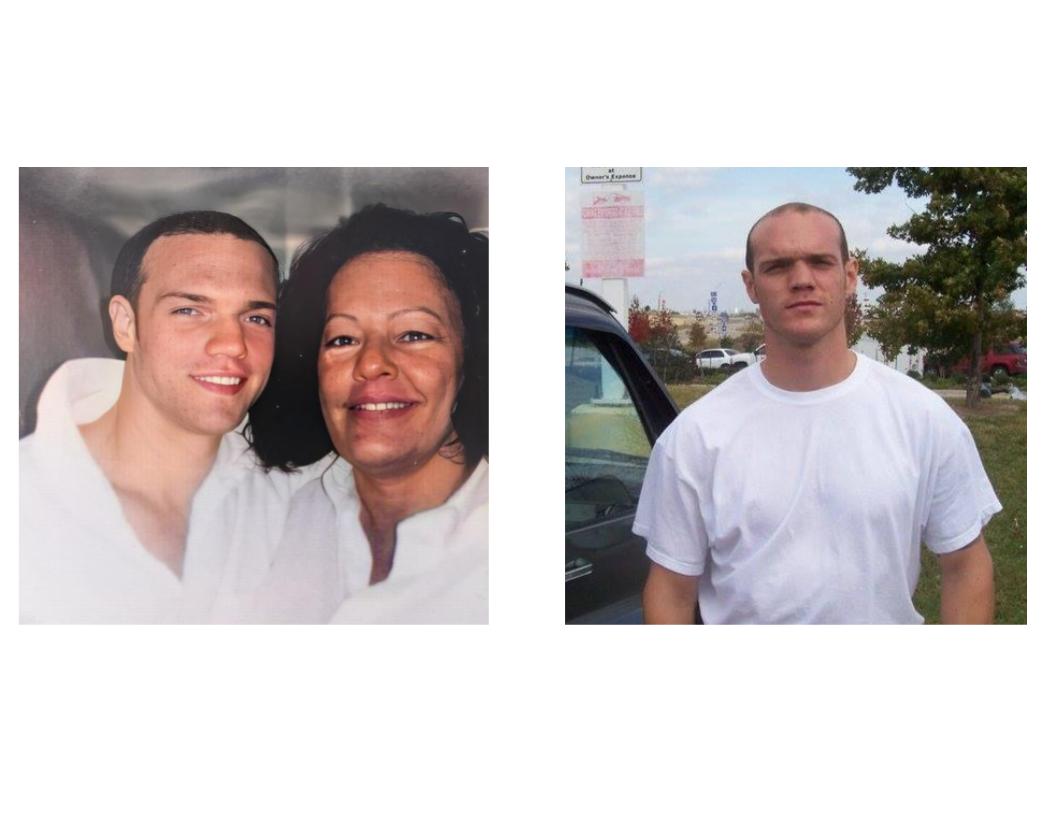
The picture on the left is of me in prison when I had my first visit with my mom. The one on the right is when I got out six years later. My smile was gone. When my dad took that photo of me that day, he said, "Son, you got that thousand-yard stare."
I had bulked up some muscle as a means of survival - my serious demeanor had kept me alive. I didn't know where I was going with my life, but I was free. My dad let me live with him and his new wife for a short time. While I was on the inside, smart phones had been invented. Everyone was using them, in a rush to be somewhere or do something. I could not believe how fast everything moved now. Prison had frozen me in time.
Prison does not prepare you for "re-entry" into society -- yes, you may have gotten some college and vocational training on the inside, but socio-emotionally, there's no coping skills preparation. If you don't have a family member or friend who supports you, you have no life raft. There's an enormous amount of pressure to start DOING life, and you already feel like you're way behind.
Most importantly, prison does not prepare you for the PTSD that slowly creeps in and then takes over. My dad was right about that thousand-yard stare.

My dad and I set out right away to clear my name. I'm Edward David James the Third, so this was a big deal.
I received parole after 5 years in prison, but I had to go through "sex offender" classes in prison for another year to make sure I was no threat to society -- even though they already knew exactly what happened in my case. But the charge is the charge -- so I had to sit next to true pedophiles, men in their 40s and 60s, never meant to be out in the world amongst children. It was chilling.
I had to take a polygraph, go through sessions with a sex offender expert, and complete class after class. The one lady who ran the class, she was as nasty as they come. I told her, Watch me: when I get out, I'm going to clear my name and a court is going to agree. She said it would never happen. I was who the charge said I was, otherwise, I wouldn't be there.
I filed pro se in the Dallas County Criminal Court to get a court-ordered exemption from the sex offender registry. I attached everything - my clear polygraph, the expert testimony assuring that I was not in any way a violent sex offender, and the police reports from 2003. They even interviewed my daughter's mother, who said the same thing as she had in 2003 - we had been in a consensual relationship. While we no longer talked, I appreciated her honesty after all those years.
My dad came with me to the hearing, which was just a few months after I had been out. Presiding Judge Gracie Lewis (I'll never forget her name) read through everything and concluded...I was right. I did not sexually assault a child. It was a consensual, nonviolent teenage relationship. I was exempted by court order from registering as a sex-offender every year, forever. That was a huge deal, huge. We walked out of that courtroom feeling relief. Finally, vindication.
I did some research and discovered that around the time I was arrested in 2003, the federal government incentivized every state with millions of dollars to get tough on sex-offenders. The more sex offender convictions a state had, the more federal Byrne JAG funding they would get. In 2003, Texas received double the previous years' awards for sex offender convictions, from $2M to $4.1M. I am all for capturing and putting away sexual predators who are dangerous to children and society, so of course I support this incentive. However, it also ended up having unintended consequences. That broader push eventually led to public discussion about whether younger people in consensual, close-in-age relationships were being treated fairly — and in 2007 the legislature adopted the Romeo-and-Juliet reforms. I was already serving a sentence by then.
I won the exemption, but I still had that charge on my record. I missed the raising of my daughter, I suffered for 6 years in prison, and there was no getting that time back. I would always be labeled on any background check as a convicted felon of sexual assault of a child, something that I was not. I hate typing it as much as you hate reading it. I could never get a mortgage, a corporate job, not even a passport.
I carried that exemption around with me everywhere. It was for "just-in-case"; you never knew what could happen if people heard about my record and didn't know the truth.

I could only stay with my dad for a short time. I couldn't get a lease with my record, so I relied on living with friends and girlfriends. It felt like there was target on my back and the best I could do was disappear in solitude. But I wanted to succeed and make a life for myself. I wanted to be a father to my daughter, who was now 7. I got a job as a groundskeeper for a golf country club and actually was given a small place on the grounds to live. On the outside, I was slowly putting my life together. On the inside, I was lost in the abyss of prison PTSD.
I tried to see my daughter right when I got out. Her mother had not made the best choices while I was in prison (I'm sure being a young teen mom was a lot for her, too) and my daughter was being raised by her grandparents. My mom had been a great grandma to her, seeing her often. The grandparents didn't want to mess up anything in my daughter's life; she was stable and happy. They said I could meet her when she was 15. I was crushed. I tried going to court to get visitation, but that didn't work. I had to settle for pictures, just like in prison. My PTSD worsened; nightmares happened every night. I would wake myself up from yelling out loud in fear. Flashes of the worst times in prison became recurring images. Crowded places gave me severe anxiety - at any moment, a riot could break out or someone could try to kill you, didn't people see that? It was hard to focus and function. I had not had a drink during the 6 years in prison, and I kept that habit once I got out. As the nightmares and memories continued to flood my mind every day, I became desperate to escape from it.
My old high school friend asked me to meet him up in Dallas at a bar. I took a sip of a beer, then another. Then whiskey. My memories dulled, and I felt better. Drinking became my answer to finally sleep at night (pass out) with no nightmares.
While I held down several jobs over the next 10 years, drinking took its toll. I moved to Amarillo where my mom lived and started my own landscaping business. I found peace and quiet among the plants, gardens, and trees. I would try and get sober for a couple months, but it didn't last. I wasn't violent, just severely depressed. I ended up in the hospital in October of 2019 because of my weakness from alcoholism; I was skin and bones and wasn't eating. They diagnosed me with PTSD from my time in prison. I stayed sober for a couple months.
That's when I finally got to meet my daughter; she was 15. It was so great, I was sober, but my heart hurt from the lost time. How do I become a dad to my 15-year-old daughter? She was just amazing; sweet but nervous, understandably. I could see how much we looked alike, and she had some of my mannerisms; it made my heart swell with pride. But she lived 6 hours away, so we didn't know when we might see each other again. Saying goodbye to her brought back all the pain. I could feel the nightmares and bad memories overwhelming me again. I stayed sober until New Year's Day of 2020, then started drinking again. I decided I would drink myself to death. Nobody cared if I lived or died.
Little did I know that I was about to jump into a new timeline that saved my life.
When I walked into reading class on the first day of seventh grade, I was a typical kid hoping for a cool teacher. She was. I still remember being struck by how young and energetic she seemed—she couldn’t have been much older than her early twenties—and how immediately I admired her. Like most twelve-year-olds, I developed a harmless crush and spent that year wishing I could grow up faster.
She was one of those teachers who made reading come alive. Beyond the required lessons, she read to us from Intensity by Dean Koontz, used Metallica’s “One” to teach reading comprehension, and had us write reflections while listening to Beethoven’s Immortal Beloved. Her class made literature feel real and emotional, and that’s why I’ve never forgotten her. When she was out sick one day, our class made a card for her. Everyone scribbled jokes and drawings. I waited until the end and wrote, “I really do love you,” signing my name beneath it. She never mentioned it; she just thanked the class and went right into another one of her creative lessons. It was a great year, and when eighth grade started, I went looking for her—but she had moved away. My classmates said she’d gone to New Jersey.
Years later, in prison, reading became my lifeline. I remembered that teacher reading Intensity by Dean Koontz, so I asked my family to send every Koontz novel they could find. I thought about her often, wanting to tell her how much her class had meant to me—but I was an inmate, and I doubted she’d remember me, let alone want to hear from me.
When I was released in 2010, it took a year to adjust to freedom. She still crossed my mind sometimes. In 2012, I found her on Facebook. I was twenty-seven then, she would have been about thirty-seven, and it struck me how little that age gap felt now that I was grown. She was married with two children and living in New Jersey.
I sent a short message thanking her for everything she’d taught me, reminding her of those lessons that had stuck with me. To my surprise, she replied: “Hi, of course I remember you! You were one of the brightest students in the class. Thank you for the kind words—I’m glad to know I made a difference.”
It made me smile. For a moment, I remembered that seventh-grader daydreaming in class, but I knew that was all it ever was—a passing childhood crush on someone who’d inspired him to love reading.
Seven years later, the world stopped with the 2020 COVID lockdowns. By then, I’d fallen deep into drinking and had convinced myself that I was drinking to die. I was living in a small two-bedroom rental that used to be a garage—nothing fancy, but it was mine. I’d taken over the lease from a friend, and the landlord was happy to have a quiet tenant who paid on time.
At the time I was in a failing relationship. My girlfriend had lived for years with a roommate named Geoff, who dealt drugs. She’d told me she wanted to get away from that life, and for a short while she moved in with me. But her loyalty to him ran deep, and the connection to that chaos followed her. I eventually ended things around Valentine’s Day, told her she needed to move out, and she went back to her place with Geoff. She was upset, and I was sorry -- but the truth was, I needed to step away from that world.
My mother and my stepbrother, who has special needs, soon moved in with me. Having them there changed the atmosphere completely. We took turns cooking, talking, watching TV—it grounded me. Not long after, my cousin, a military man, took me to lunch and handed me a book called Declare War on Yourself. It was about reclaiming your life. He told me I needed to stop hiding my story and start telling it—maybe even build a website about what had happened and what I’d learned. The idea scared me, but it lit a spark.
That breakup was a positive turning point for me. For the first time in years, I felt a flicker of life again. My spirit was waking up. That’s when I got my dog—an energetic puppy I named Phoenix. It felt like the right name. After a decade of ashes, I was finally starting to rise from them.
Getting Phoenix felt like being reborn. I was still drinking, but I’d begun to have stretches of clear days— I’d save it for weekends, play guitar, write songs, and feel a hint of peace returning. In March, I posted something on Facebook about healing from everything I’d been through. Then I saw her comment—my old seventh-grade teacher, the crush I’d never forgotten.
“I’m so happy to hear this. You were always the brightest student in my class, and I know you’ll do great things.”
Her words caught me off guard but filled me with hope. She remembered me—not as an ex-inmate or a drinker, but as the bright kid with potential. It was like being seen again for who I used to be. I replied, “Thank you for the kind words. I’ve been through some things, but I’m determined to rise above it and be the best I can.”
Days later, she wrote back:
“What have you been through? I’m so sorry to hear that you’ve suffered. I always thought you’d go on to do great things. I have a restaurant that had to close during the lockdowns, so I have time if you want to share. Best of luck on your healing journey.”
Her message echoed my cousin’s advice: It’s time to tell your story. I asked if we could talk by phone, but she said she preferred typing. So I wrote out everything—from 2003 onward. Tears streamed down my face as I relived it all. She was kind, shocked, and compassionate. Her sister, now a therapist, remembered me too and even offered some advice through her.
Then came the words that changed everything: “I’m not a phone person, but I can FaceTime if you’d like, so I can tell you what she said.”
FaceTime—with her. After twenty-two years. We set it for 10 a.m. the next morning. I caught my reflection in the mirror—bald, bearded, tattooed, older—but still me. Would she see that?
We talked for two hours. She laughed when I told her she looked exactly the same. “The only thing I recognize about you is your eyes,” she said. “The rest is full-grown man. I can’t believe I was your teacher. Call me Kelly—don’t you dare call me Miss Lepine.” Then, smiling: “Wait, how old are you now?”
“I’m thirty-five," I said.
Her eyes widened. “Wow, we’re only about ten years apart. That’s crazy.”
She looked twenty-five. The connection between us felt instant and undeniable. We FaceTimed again, and again. She wanted to follow my healing progress, but soon it was clear: there was a spark neither of us could ignore. We talked for hours, sharing thoughts on life, freedom, and the chaos of the pandemic. I’ll leave the details of her marriage private out of respect, but things moved quickly.
On May 2, 2020, she said, “This is the craziest thing, but I feel like I’m meant to be with you.” I felt the same way. Seven days later, her husband had filed for divorce online. By June, we met in person. It felt destined. I started planning a move to New Jersey to be with her.
For a while, I managed my drinking. Life felt lighter, full of purpose again. I marked every sober day as a small victory. But while I was celebrating my new life, something else was happening behind the scenes.
On June 30, 2020, Kelly and I were on FaceTime, talking about the future, when two U.S. Marshals pulled up outside my house.
“Can I help you?” I asked, heart racing.
“Are you Edward James?”
“Yes…”
“You’re under arrest for the assault of Becca Smith.”
The world went silent. Becca—the ex-girlfriend from months earlier. Kelly saw everything through the screen as the officers read me my rights. I told her I’d call when I could. Then came the cold click of handcuffs—an old, familiar sound I’d sworn I’d never hear again.
They booked me and put me in the tank with the others. I didn’t know what was happening, but if Becca was involved, then Geoff probably was, too. At arraignment, the judge said the charge was assault with impeding breath. I was stunned. Impossible. When? How? I knew nothing. No one gave me any explanation.
I pled not guilty, posted bail, and was released three days later. But those three days in jail reopened everything I’d worked to bury. The memories of prison, the panic, the shaking—all of it came flooding back. On the way home, I stopped at a liquor store. The PTSD had me trembling; I needed whiskey to quiet my nerves.
When I called Kelly on FaceTime, she listened quietly as I tried to explain. “It’s okay,” she said. “I love you. One day at a time.”
“I never assaulted her," I told her. "I never impeded her breath or whatever they call it. But I have a good idea who might have.”
I’d seen Geoff manhandle her, yell, curse, use her for rent money while spending his own elsewhere. I’d watched her lie to police once before—to protect him after a drug deal turned violent. He was out on probation, and if caught with a gun, he’d go back to jail. She covered for him, and the charges disappeared. Her loyalty to him was absolute.
My mind spun. Why hadn’t police even questioned me before arresting me? Did they really take one person’s word as enough? Surely not. Yet here I was, arrested without even knowing she had accused me of anything, with no opportunity to respond except at a trial now.
I didn’t let the arrest stop me from moving forward with my new life. As part of my bail, I only had to check in by phone every Thursday. It was fine if I moved to another state, as long as I called in each week, which I did for four years until my trial. I hired a Texas law firm that advertised its experience and statewide recognition, and I trusted that they would handle my case properly.
I moved to New Jersey at the beginning of August. Within a week I found work at a marina and rented a small hotel room near the restaurant Kelly ran with her sister. Our relationship was what people hope for in live—genuine love and connection. I used to tell her she’d saved my life. She’d smile and say maybe so, but that I’d saved hers too.
I was still drinking but trying to match her pace, believing I could keep it under control. I liked my job, was making steady money, and moved into an apartment by October. By November 2020, everything looked brighter by the week. I wasn’t worried about Amarillo—my lawyer said there was no evidence, and I trusted his perspective that the charges would probably be dropped.
I sought counseling for my PTSD. When I stayed sober, I could feel myself healing. But drinking brought it all crashing back. Kelly saw it, and she finally put her foot down. I set a new goal—to stop completely. I read recovery books, signed up for programs, tried everything. Some weeks were great; others weren’t. We’d fall back to the idea that moderation might work this time.
Meanwhile, my boss at the marina offered me a chance to open my own restaurant in a small space that had closed during COVID. Kelly and her sister agreed to help. We planned to open in May 2021—I was going to be a co-owner.
That’s the turning point—the one that became the seed for Phoenix Reformation, the nonprofit I later founded to help others in recovery. Because when I say I know what you’re going through, I mean it. I had everything: a woman who loved me, a business on the horizon, a fresh start. And still, I let alcohol creep back in. That’s what addiction does—until you beat it for good.
Christmas was beautiful, but by January I was drinking again. I started hiding it; Kelly knew. By late February she called, heartbroken and angry, and ended things. I begged her to give me another chance, but she hung up. She’d never done that before. She was really done. I had gotten the girl and then lost her. Ashamed, I realized I couldn’t get sober on my own. God, if you’re there, take over for me.
That prayer was answered almost immediately. A man overheard me saying I needed someplace different—somewhere between inpatient and outpatient treatment—to truly get sober. He told me about Coming Full Circle (CFC), a sober-living home for men who genuinely wanted recovery. It wasn’t rehab, but it had curfews, testing, and peer classes. A room cost $80 a week. He wished me luck and walked away; I never saw him again.
I called CFC that day and they welcomed me in. My new home was a big house with eight other men and a house manager. It felt right, like God had handled it for me. I didn’t give up on Kelly. I called often, updating her on my progress. She was distant, but she always answered.
Getting sober was hard. But living among others who were doing the same changed everything. I completed a six-week SMART Recovery class, and something clicked. I even trained to become a facilitator. The cravings still came, but I learned to sit with them and remind myself they would pass. At first I stayed sober for Kelly. Then, slowly, I was doing it for me.
CFC worked miracles. I liked how clear and energized I felt. I had fun at sober outings—camping, concerts, dinners—real fun, not the kind numbed by alcohol. Around 60 days sober, I asked Kelly if I could help at the restaurant. She agreed. Post-COVID, reliable staff were hard to find, so I did everything: payroll, dishes, serving, cooking. Despite the stress, I didn’t think about drinking. I’d worked too hard to go back to Day One.
At 90 days, they say your brain rewires. I didn’t believe it—until I felt it. The craving was gone. I pictured whiskey, wine, beer: nothing. If anything, the thought repelled me. For the first time in sixteen years, I felt free. I’d spent six years in a physical prison and ten in a mental one. Now I was truly out. I wanted everyone still struggling to know that freedom too. That’s why I founded Phoenix Reformation—to help others rise from the same ashes.
Kelly and I still talked, though she avoided seeing me. I knew why—she didn’t want to risk feeling what we both still felt. One day, at the CFC center, the director called me into his office. “Kelly dropped off donations,” he said, “but she accidentally included a box of restaurant T-shirts. She’s coming to pick them up. Why don’t you carry them out to her car?”
He had me at “Kelly.”
When she arrived, she looked surprised to see me carrying the box. I looked healthy again, clear-eyed, steady. She stepped out of the car. “I didn’t know you were going to be here,” she said, her eyes welling up with tears. She began to cry.
So did I. I set the box down and hugged her. “Please don’t give up on me,” I said. “I’m sober. I don’t crave alcohol. I love this life—and I love you.”
She wiped her eyes, half laughing. “I could never stop loving you, even if I tried. And I’ve tried.”
She smiled that same smile I’d never forgotten. With Kelly back in my life, I felt ready for anything—even that old 2020 charge still hanging over me. My lawyer had it handled, I thought. He’d call any day with good news.

The summer of 2021 was about proving to Kelly—and to myself—that I was truly sober for life. We worked together at the restaurant, then took weekend getaways to the Delaware River, hiking to waterfalls or canoeing through calm water.
My daughter was seventeen, busy being seventeen, and I assumed she didn’t want much to do with me. Our contact was mostly a few texts here and there. Then, out of nowhere, I got the call every father hopes for: “Dad, I’m taking you up on your offer to come visit. I want to see you.”
I called her grandparents to assure them she’d be safe and that I was sober and doing well. I booked her ticket, and she flew in. She stayed for nearly a week, and it was the beginning of the relationship I’d dreamed of. She reminded me so much of myself—driven, funny, and openhearted. She loved Kelly and her daughter; they all clicked instantly. The timing couldn’t have been better. I told her I planned to propose to Kelly on horseback, and she was thrilled to be part of it. I proposed, Kelly said yes, and we all celebrated.
By then, I had become a certified facilitator of SMART Recovery, teaching classes at CFC and helping others on their journey. I even appeared in their annual gala video as one of their success stories. It felt incredible to tell people, “Believe me, if I can do it, anyone can.”
When my daughter left, my heart didn’t ache this time. We’d finally reconnected, and I knew we’d only grow closer from there.
Kelly and I bought a ranch surrounded by woods and married in February 2022. The wedding was magical—family and friends dancing, sparkling apple cider instead of champagne, and vows that said everything we felt.
While packing her old classroom keepsakes, Kelly found a card from the year I was her student—the one where I’d written, I really do love you. Twenty-four years later, there it was, in her hands.
She looked at me, amazed. “No way. This is so crazy.”
“I told you I’ve loved you since the day I saw you,” I said. And I meant it.
By then, it was March 2022—almost two years since I’d been arrested and charged back in Texas. I still hadn’t heard much from my attorney.
That should have been a red flag.
By 2020, my case had already been reassigned twice within the same law firm. I was now on my third attorney, and progress seemed nonexistent. When he finally reached out, he said he had just obtained the case file and was “shocked at the paucity of evidence.”
There was nothing connecting me to the charge—only the accuser’s word. Her statement wasn’t even written by her but by a friend. The photos she submitted didn’t match the report, which claimed she’d been punched repeatedly in the face. The first photo showed no swelling, bruises, or visible marks. My attorney couldn’t believe the prosecution’s only offer was five years in prison.
“It doesn’t make sense,” he said. “You’re nearly 40, you have no criminal history—your prior case was judicially exempted. Why five years? Why won’t they negotiate?”
My heart sank. The answer seemed obvious. The detective must have checked my record, seen the old 2003 charge, and not realized it was exempted. He saw that label and thought, “We’ve got our guy.”
Later, as I reviewed the trial record myself, I confirmed that’s exactly what happened. The accuser claimed the assault occurred in late February 2020. The detective’s notes show his first contact with her wasn’t until March 18. He asked her for my phone number, though it was right there on the report. She gave him a number he didn't verify. He called, couldn’t leave a voicemail, and that same day ran a criminal history check on me. After seeing “Sexual Assault of a Child,” it appears he closed the case. He didn't attempt to go to my house and interview me about the accusation. His note read simply: “This case will be sent to Potter County DA.” That was it—no further investigation.
In 2025, I filed an Internal Affairs complaint (see Evidence tab) regarding the handling of my case, citing several TCOLE and procedural issues and including supporting documentation. Two weeks later, the department sent a brief letter stating that all claims were “Unfounded.”
Kelly followed up by email to request clarification on how each item had been reviewed. The response from the division head was brief: “Your husband was found guilty by a jury, and no internal affairs complaint is going to change that.”
It was disappointing, not because of disagreement with the outcome, but because our questions about process and accountability went unanswered.
In March 2023, we had a Zoom call with my attorney, and Kelly joined.
“I don’t understand,” she said. “What evidence even points to him? Are they bluffing? Have they shown you everything they plan to use?”
He replied, “I’m filing a motion for discovery. They’re required to turn everything over. It’s been three years—nothing new is going to suddenly appear.”
I asked, “And the prosecutor knows about my affidavit, the details about Geoff Jackson, and that my 2003 charge was exempted, right?”
“Oh yes,” he said. “They’ve got it all. They’re just not responding to emails. Honestly, I think if we keep pushing for trial, they might drop the case. There’s no way you’re taking a five-year plea.”
But they didn’t drop it.
By November, he called again: “Apparently there are some Facebook messages you sent her in 2020. Do you have copies?”
“No,” I said. “I deleted everything from that life years ago. What messages?”
“I’m not sure,” he said. “The prosecutor mentioned them, but I haven’t seen them yet.”
Looking back, the wiser version of me would have said: “What do you mean you haven’t seen them? You filed for discovery eight months ago—demand production or move to compel.”
But I trusted my attorney. I assumed he knew what he was doing. Then, the Thursday before the January 2024 trial, he emailed: “I got those Facebook messages.”
Attached were screenshots—supposedly from 2020—showing me apologizing after an argument. The date matched the alleged incident. I was confused. We had argued, yes, but not on that date. I apologized, yes, but not for assaulting her; for ending things and making her move out. I didn't recognize some of the messages, and parts about Geoff that she would tell me frequently were not there - and the dates did not match up to what I knew. Something didn’t add up. Why were these being handed over four years later, right before trial?
The new and informed me would have recognized it for what it was: a last-minute ambush disclosure, possibly a Brady violation. Authentic evidence would include metadata or a forensic trace, not last-minute screenshots. I should have demanded a continuance and a forensic review. But I didn’t know then what I know now. I trusted the process. My attorney said he’d challenge the admissibility during trial.
Kelly and I flew out from Newark, but our connection in Dallas was canceled by a blizzard that blanketed the state. We spent the weekend stranded at DFW, unable to reach anyone. My gut told me this was wrong—deliberate, even—but I kept faith that my lawyer would handle it. I couldn’t wait to take the stand and finally tell my side.
We arrived at the courtroom straight from the Amarillo airport on January 16, 2024. My attorney greeted us and said, “You haven’t missed anything. We’re about to start with pre-trial motions—mostly formalities about the 2003 charge.”
Even now, it makes me sick to think about. That hearing was his chance to argue against letting the 2003 charge be mentioned at all—it was legally exempt and inadmissible. After the hearing, he told me, “It looks like the 2003 case will come up. I strongly advise you not to take the stand.”
“Why?” I asked. “I can explain it—it was exempted, and I’m proud of how far I’ve come.”
He sighed. “Because the prosecutor will make sure the jury believes you were convicted of sexually assaulting a child. And there’s nothing juries hate more than that.”
Kelly stepped in. “But if he doesn’t testify, how will the jury hear the truth about Becca and Geoff?”
“That’s true,” my attorney said, “but I think I can raise enough doubt without him. Between inconsistencies in her story and your mom’s testimony, the jury should see it.”
It didn’t feel right. Kelly shook her head, and I could tell she felt the same.
Inside the Courtroom
The prosecution called three witnesses: Becca, her friend, and her co-worker. None of them actually saw anything—they only testified that she arrived upset, saying I had assaulted her, but neither of them knew where she lived at the time or where she had come from. The co-worker took the photo that became the State’s Exhibit 1 and then forced her to go to the police station, which she testified she did not want to do.
When I finally saw the photo projected in court, I felt a wave of relief. It showed no swelling, bruising, or marks—just Becca, unsmiling. Surely the jury would see that too.
But then came the rest. My mother testified, but the prosecutor confused her on dates. She’d had a stroke months earlier, and though she lived with me during the time in question, he made it sound uncertain. I kept thinking: If the detective had simply come to my home in 2020, he could have spoken to her and confirmed all of this. Instead, we were left to prove something four years later.
The Facebook Messages
On Day Two, the prosecutor introduced the Facebook messages. My attorney objected outside the jury’s presence and even demonstrated in court how easily fake messages could be created. He produced one that looked exactly like her screenshots to show the judge how convincing forgeries could look. The screenshots showed my Facebook profile photo from Christmas 2023, just three weeks before the trial.
Neither the judge nor the attorneys seemed confident about how Facebook data actually worked. They said that since I was a party to the messages, the burden was on me to show they were false. But I had deleted all my Amarillo contacts years ago; also, I couldn't produce messages I didn't write. There was nothing I could use to disprove them.
Despite my attorney’s six objections, the judge allowed the screenshots in—no metadata, no source verification, just her word and an in-camera review of her phone, which does not show deletions, timestamp logs, etc. At that moment, my attorney could have—and should have—requested a continuance to have them forensically analyzed. That never happened.
The Decision Not to Testify
Right before resting the case, I asked again if I should testify. My attorney repeated that doing so would allow the prosecutor to “turn me into a pedophile” before the jury. He promised his closing argument would be enough.
It wasn’t. He ran out of time. The judge cut him off. I want to be clear: my attorney wasn’t malicious. He was a kind man—but ineffective. His errors weren’t strategic. They were avoidable.
The Verdict
The jury deliberated for two and a half hours. I’ll never forget the foreman’s voice saying “Guilty.” It felt like my spirit left my body. Kelly later told me I fainted. Officers carried me from the courtroom. I remember thinking: This can’t be happening again. Not after twenty-two years. Not after rebuilding my life.
Sentencing
The next day, I could barely walk. The tears came in a steady stream. When the prosecutor addressed the jury, his first words were: “This guy has messed up before. In fact, he’s been in prison—for sexual assault of a child.”
Then he handed them the Penitentiary Packet with my old mugshot next to those words. You could feel the jury's disgust in the room; it was palpable. I sat there in grief and disbelief. My attorney had told me the 2003 charge would never be mentioned if I didn’t testify. Kelly confronted him right there. “You said if he didn’t testify, they couldn’t bring it up,” she said.
“Only during trial,” he replied. “Sentencing is different.”
“If we’d known that,” she said quietly, “he would have testified.”
Becca took the stand again to argue for the maximum of ten years in prison. You can read the sentencing transcript on the Evidence tab. Briefly, the message to the jury was that I ruined Becca's entire life, including her future. She also volunteered that “because of me,” she had recently crashed her car into a telephone pole while driving drunk. The prosecutor told the jury I was to blame for that as well. Hearing that in open court was surreal.
Because of that prior assault charge, even though it was exempted, I faced mandatory prison time. My trial counsel never told the jury about my exemption from that charge; He made it seem like he couldn't mention it. Now I know from consulting with other criminal defense lawyers, he had a duty to do so. It was up to him to disclose the truth of it to the jury in his argument for leniency. But he didn't address it all. They sentenced me to five years.
Aftermath
That night in the Potter County tank, an inmate said to me, “You should motion the court to get released on bond pending appeal.” Minutes later, officers removed him. Another angel, maybe.
I filed the motion. After 31 days in jail, Judge Dee Johnson granted my release on bond pending appeal. I’ll always be grateful for her fairness in that moment.
While on bond in Amarillo, I threw myself into faith and service—Bible study, volunteering at a homeless shelter, and starting a nonprofit to help men in recovery. I enrolled in Amarillo Community College to train as a chaplain. I believed truth would prevail in my appeal. I was allowed to move back to New Jersey in August 2024 and was thankful to Judge Dee Johnson for her fairness once again. I continued my study and service there.
On January 29, 2025, I lost my first appeal. My PTSD returned full force. After years of perfect compliance, I couldn't bring myself to check in with my bondsman out of sheer paralysis and anxiety. My bond was revoked while I waited on my second appeal.
Months later, I lost that one too. But by then, I had consulted with several Texas defense attorneys who looked at my case, and I learned what I should have known all along: none of this should have happened the way it did. If I had a chance to be retried, it would be a completely different trial.
October 1, 2025: Thank you for being here as we work to get Edward a new trial with his Petition for Habeas Corpus. As you may have read on here, after sentencing, the judge released him on bond pending appeal in Feb of 2024 and allowed him to live back in New Jersey. After losing his first appeal in January 2025 and his PTSD paralyzing him, he stopped checking in with his bondsman. While there was a bond surrender warrant issued on February 3, 2025, no law enforcement agency ever attempted to serve it. Edward lived openly at his approved home address while he continued his second appeal. In July, 2025, the Texas court of appeals issued their mandate and ordered him back from NJ to serve his 5-year prison sentence. Edward prayed constantly about what to do. His PTSD from Texas prison made him mentally unable to buy a ticket and put himself on a plane. He still had one more chance at appeal: the habeas corpus petition for wrongful custody. Yet he wanted to comply with Texas law and surrender to them. Instead of buying the plane ticket, he thought maybe he could surrender to his local county Sheriff in New Jersey on behalf of Texas.
It turned out, he could do that. Reporting to jail in New Jersey on behalf of Texas still counted as surrendering for the Texas mandate. He found a defense attorney in NJ who said he would help him surrender voluntarily. On July 24, 2025, he turned himself in to his local NJ police station to begin the process of staying extradition pending the Habeas Corpus (wrongful imprisonment) process. You will see in public records he was "arrested" as a "fugitive"; we want to be clear that he always lived exactly where Texas allowed him to be (at home) and reported to jail voluntarily when the Texas mandate was issued.
The plan is to file the Habeas Corpus for a new trial based on constitutional violations while asking the NJ Governor's office to stay extradition pending the outcome of the Habeas. If he is granted a new trial, he will not stay silent this time and looks forward to testifying. Edward is in Ocean County jail, and he wants you to know that while every jail is a terrible experience, he is in good spirits knowing he is doing whatever he can do within the judicial process to clear his name. He knows God is with him. To you, Edward says hello, thank you, and God bless you.
Sincerely,
Loved Ones and Supporters of Stand With Edward James
ALL FURTHER UPDATES ON THE UPDATES TAB